

Spoiler alert: This post discusses plot details from episode 4 of Netflix’s Little House on the Prairie.
An entire household stuck in bed with fever isn’t exactly the stuff of gripping drama, which is the puzzle Little House on the Prairie showrunner Rebecca Sonnenshine had to solve for the Netflix series’ fourth episode. The installment pulls from the “Fever ‘N’ Ague” chapter of Laura Ingalls Wilder’s book, in which the Ingalls family in Independence, Kansas is laid low by what turns out to be malaria, spread by mosquitoes but not yet understood as such by the people living through it. Rather than shoot several characters lying still and sweating for an hour, Sonnenshine turned the illness itself into a storytelling device, using fever-induced hallucinations as a backdoor into flashbacks the show hadn’t gotten to yet.
It’s a move Sonnenshine has made before. She pointed to a heavily dream-based episode from her prior series, Archive 81, as a sign that this kind of feverish, hallucinatory sequence has become something of a recurring tool in her writing toolkit whenever a project leans into genre. Here, it lets three generations of Ingalls women each get a hallucination of their own. Charles (Luke Bracey), delirious, is visited by memories of his younger brother George (Connor Paton), who ran off to enlist in the Civil War. Caroline (Crosby Fitzgerald) sees her sister Eliza (Catherine Bérubé), who’d made clear back in episode 3, through a letter the show had already planted on screen, that she disapproved of Caroline heading west with Charles. According to Sonnenshine, that setup finally gives those earlier hints a payoff and turns what could’ve been a static, bedridden episode into a piece of family history the audience actually has a stake in.
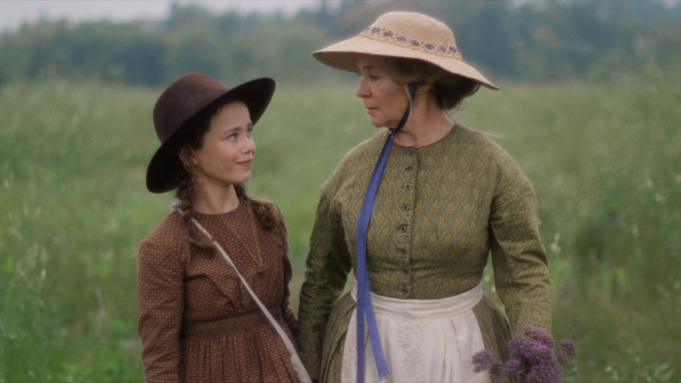
Laura (Alice Halsey) holds out the longest against the fever, something the show attributes to the coffee she’s taken to drinking with her father, and for a stretch of the episode she’s the only one well enough to keep the household running while her parents and sister Mary (Skywalker Hughes) are stuck in bed. Once the sickness finally does catch up with her, her own vision pulls in a different direction than her parents’: she sees Grandma Ingalls (Megan Follows), still living back in Wisconsin’s Big Woods, a callback the season has kept returning to as a nod toward Wilder’s earlier book, Little House in the Big Woods.
Sonnenshine told Deadline that the outbreak storyline also doubles as a kind of period-piece stand-in for the early days of COVID-19, when nobody yet had a reliable answer for how the virus was spreading. The show is deliberately careful not to let its 1870s characters reason about the fever with knowledge they couldn’t have had, leaving them to grope toward answers the way the real world did in 2020. That same tension plays out in the episode’s quinine subplot: Gemma James (Mary Holland) sits on her own private supply instead of sharing it with sick neighbors, a decision Sonnenshine framed as coming from a very human, if not especially admirable, instinct to protect her own family first. It’s Dr. Tann (Jocko Sims) who eventually gets more of the medicine to where it’s needed, with an assist from Lacey Aubert (Rebecca Amzallag), who tips him off that Mr. Edwards (Warren Christie) has been quietly hoarding a stash of his own.
One thing Sonnenshine wouldn’t confirm is whether any of this is setting up Mary’s eventual blindness, brought on by scarlet fever in Wilder’s later book On the Shores of Silver Lake. For now, the episode works as its own contained story, using fever and delirium to fill in gaps in the Ingalls family’s past that a straightforward sickbed episode never could have.