

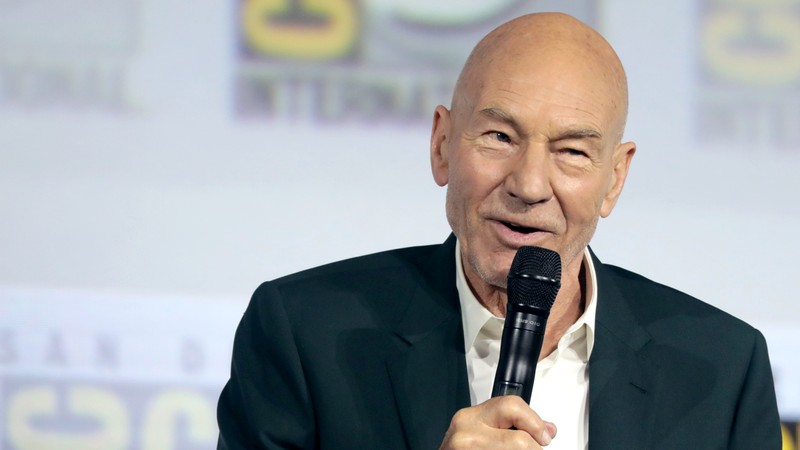
Sir Patrick Stewart, the classically trained actor who crossed over from Shakespeare to the stars as Captain Jean-Luc Picard, has died. He was 86.
Stewart died on Wednesday at his home in Los Angeles, in the care of his wife, Sunny Ozell. His family announced the news on Thursday in a statement shared on his official social media accounts, saying he had followed what they called “a brief and poignant journey with Alzheimer’s Disease and Lewy Body Dementia,” and that he spent his final days held in what the family described as the warm embrace of family and friends.
For millions of viewers, Stewart will always be seated on the bridge of the USS Enterprise. Cast in 1987 as the captain of Star Trek: The Next Generation, he gave the franchise a different kind of hero: thoughtful, measured and quietly commanding, a diplomat as much as a starship officer. Across seven seasons and 176 episodes, his Picard became the moral center of the series, and his crisp orders, “Make it so” and “Engage,” entered the language. He carried the role into four films, Star Trek Generations, Star Trek: First Contact, Star Trek: Insurrection and Star Trek: Nemesis, then returned a generation later as both star and executive producer of Star Trek: Picard, which ran three seasons and brought his captain’s story to a close more than 35 years after it began.
He built a second screen legacy in a wheelchair rather than a captain’s chair. As Professor Charles Xavier, the telepathic founder of the X-Men, Stewart first appeared in X-Men in 2000 and played the role across more than two decades of films, earning a Guinness World Record for the longest career as a Marvel character. Audiences will see him one final time as Xavier in Avengers: Doomsday, opening in theaters this December.
Long before Hollywood called, Stewart was a giant of the British stage. Born on July 13, 1940, in Mirfield, Yorkshire, the son of a textile worker and a regimental sergeant major in the British Army, he left school at 15 to act and trained at the Bristol Old Vic Theatre School. He joined the Royal Shakespeare Company in 1966 and remained a fixture there until 1982, winning three Olivier Awards along the way, for Antony and Cleopatra, for playing Claudius in Hamlet, and for his one-man A Christmas Carol, in which he played more than 40 characters and also won a Drama Desk Award. He earned a Tony Award nomination for Macbeth and, late in his stage career, toured to acclaim alongside his close friend Ian McKellen in Waiting for Godot and No Man’s Land. It was McKellen, in one of the great pieces of ignored advice between friends, who had urged him not to take the Star Trek job.
Early screen work had already hinted at his range, from the scheming Sejanus in I, Claudius to King Leondegrance in Excalibur and the loyal Gurney Halleck in Dune. Queen Elizabeth II knighted him in 2010 for services to drama. He told his own story in his 2023 memoir, Making It So, and used his fame steadily on behalf of others, championing survivors of domestic violence, a cause rooted in violence he witnessed as a child, and supporting human rights, refugees, veterans’ mental health and animal welfare, alongside his much-loved work fostering pit bulls. He served as Chancellor of the University of Huddersfield and never lost his devotion to Huddersfield Town, the football club of his home county.
UPDATE, Thursday, Oct 29, 4:34 p.m.: William Shatner tribute added.
William Shatner, the original Captain Kirk and Stewart’s co-star in Star Trek: Generations, paid tribute in a statement on Thursday. Shatner called Stewart “a friend, a colleague, and a magnificent actor,” writing that from the stage to the bridge of the Enterprise, he brought intelligence, grace and a deep sense of humanity to everything he did. “Captain Picard stood for the best of us, and so did the man who played him,” Shatner wrote, closing with his heart going out to Sunny and the family.
Stewart is survived by his wife, Sunny Ozell, and his children, Daniel and Sophie. In lieu of flowers, his family has asked that memorial contributions be made to the Johns Hopkins Alzheimer’s Disease Research Center Fund and the Alzheimer’s Foundation of America. The captain has left the bridge, but the order he gave a generation of fans still stands: make it so.