

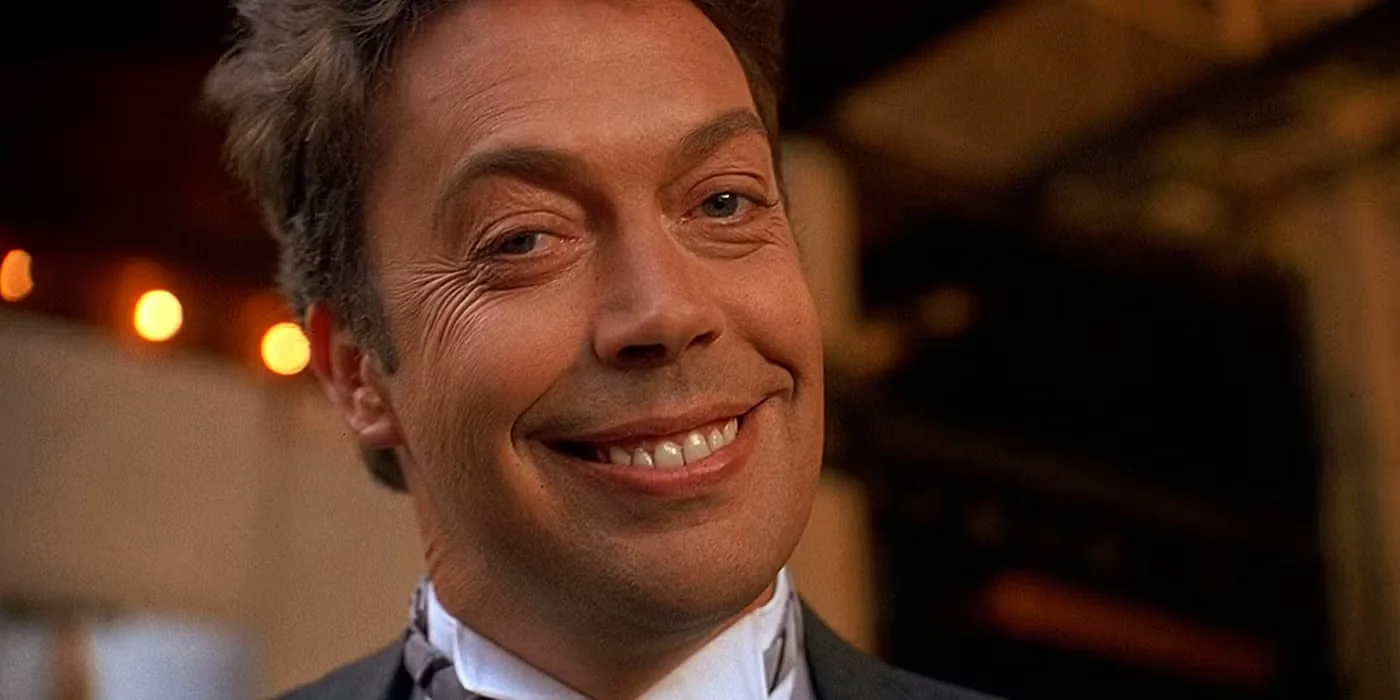
Tim Curry, the singular British actor whose extraordinary career carried him from the London stage to some of the most memorable performances in film, television and animation, has died at the age of 80.
Curry died at his home in Los Angeles on August 25, according to his longtime manager and friend, Marcia Hurwitz. His death was also confirmed by his publisher, with multiple major news organizations reporting the news on August 26. A cause of death had not been publicly disclosed at the time of publication.
For generations of audiences, Curry was far more than a familiar face. He was an actor who could transform himself so completely for a role that the performer sometimes seemed to disappear behind the character. His career was defined by that remarkable versatility, but also by a distinctive voice, commanding presence and ability to find something memorable in even the most unusual characters.
Curry was born April 19, 1946, in Cheshire, England, and began building his professional career on the London stage. His early work eventually led him to the role that would change his life and make him an enduring figure in popular culture: Dr. Frank-N-Furter in “The Rocky Horror Show.”
Curry originated the role in the original stage production in London in 1973, and he carried the character into the 1975 film adaptation, “The Rocky Horror Picture Show.” The performance became one of the defining screen portrayals of the 1970s. As Frank-N-Furter, Curry combined theatricality, humor, confidence and an unmistakable musical presence, creating a character that audiences could not easily forget.
The film itself did not immediately become the phenomenon it would eventually become. Its original theatrical run was modest, but midnight screenings transformed “The Rocky Horror Picture Show” into a cultural institution. Audiences began returning repeatedly, dressing as the characters, talking back to the screen and turning screenings into participatory events. The film’s unusual longevity and devoted following ultimately helped establish the midnight-movie tradition as an important part of American film culture. In 2005, the Library of Congress selected “The Rocky Horror Picture Show” for preservation in the National Film Registry, recognizing it as culturally, historically or aesthetically significant.
Curry’s contribution to that legacy cannot be separated from the energy he brought to Frank-N-Furter. The performance gave audiences permission to embrace theatricality, individuality and a willingness to step outside conventional expectations. For countless fans, “The Rocky Horror Picture Show” became more than a movie. It became a communal experience, and Curry’s performance was at its center.
Yet reducing Curry’s career to Frank-N-Furter would overlook just how much ground he covered as a performer.
He became equally recognizable to many viewers through his work as a villain and character actor. In “Clue,” he brought manic comic precision to Wadsworth, delivering a performance that has remained a favorite with audiences decades after the film’s release. In Stephen King’s “It,” he took on the role of Pennywise, creating a version of the character that became one of the most recognizable horror performances of its era. He later appeared in films including “Legend,” “Home Alone 2: Lost in New York” and “Muppet Treasure Island.”
Then there was his work in animation and voice acting, an area in which Curry proved that his famously expressive voice could be just as powerful without his physical presence on screen. He became the voice of Nigel Thornberry in “The Wild Thornberrys,” introducing an entirely different generation to his talent. His voice work also extended across numerous animated series, films and video games.
The stage remained an important part of Curry’s career as well. He earned Tony Award nominations for performances in “Amadeus,” “My Favorite Year” and “Spamalot,” with his portrayal of King Arthur in “Spamalot” bringing him another major chapter of Broadway success.
That range is perhaps the best way to understand Curry’s legacy. He was not simply the star of a cult movie, although that alone would have secured him a place in entertainment history. He was a theatrical performer who understood the power of exaggeration, a dramatic actor capable of menace and vulnerability, a comedian with precise timing, a singer, a voice performer and an actor who could move comfortably between wildly different forms of entertainment.
There was also something unusually generous about the way Curry approached performance. Whether he was playing a flamboyant scientist, a sinister supernatural figure, a fast-talking butler or a cartoon adventurer, he committed fully to the world of the character. He never seemed embarrassed by the material. Instead, he understood that audiences respond when a performer believes completely in what they are doing.
That quality helped make him particularly influential to audiences who discovered his work outside traditional Hollywood stardom. Curry demonstrated that a performer did not need to fit neatly into one category. He could be glamorous one moment, frightening the next and completely absurd after that. His career helped make the unconventional feel accessible.
That cultural impact is especially evident in the continued life of “The Rocky Horror Picture Show.” The film became a place where audiences could gather, participate and celebrate the strange, the theatrical and the unexpected. Its influence reached well beyond its original era, and Curry’s performance remained at the heart of that phenomenon more than five decades after he first stepped into the role.
Curry continued working for many years, even after suffering a stroke in 2012 that dramatically affected his mobility. He remained active through voice work and occasional appearances, and he continued to be embraced by fans whose connection to his performances had lasted for decades. His reflections on his career in later years offered a reminder that behind the larger-than-life characters was an actor who had spent much of his life committed to the craft of performing.
In the end, Tim Curry’s career cannot be summed up by a single performance, even one as iconic as Frank-N-Furter.
He left behind an extraordinary collection of characters that reached audiences in theaters, on television, on Broadway and in living rooms. Some frightened us. Some made us laugh. Some inspired audiences to sing along. Others simply made an unforgettable impression in a few minutes of screen time.
What connects them is Curry himself: the voice, the timing, the intelligence and the unmistakable presence of a performer who understood that memorable acting sometimes requires taking a risk and giving yourself completely to the role.
Tim Curry’s work will continue to introduce him to new generations. Someone discovering “The Rocky Horror Picture Show” for the first time will still encounter Frank-N-Furter. Someone watching “It” will still meet his terrifying Pennywise. Someone revisiting “Clue” will still hear Wadsworth racing through the house. And someone watching “The Wild Thornberrys” will still hear Nigel Thornberry’s unmistakable voice.
That is the measure of a lasting performer.
Tim Curry did not simply appear in popular culture. He became part of it, leaving behind performances that audiences will continue to revisit, quote, celebrate and remember.
His loss is felt not only by those who knew him personally, but by generations of viewers who found something unforgettable in his work.
Tim Curry was 80.