

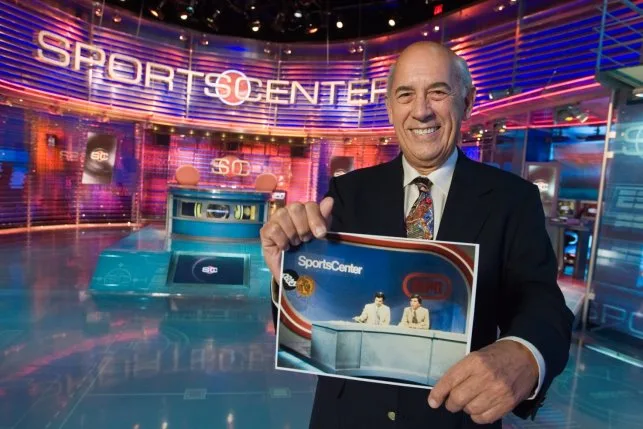
The history of American television changed on September 7, 1979, when a new network from Bristol, Connecticut, went on the air with an idea that seemed almost too ambitious for its time: a television network devoted entirely to sports.
That network was ESPN, and behind the idea was Bill Rasmussen, a former sports broadcaster and entrepreneur who believed television could do something the traditional broadcast networks had largely been unwilling to do. Instead of treating sports as programming that appeared at certain hours or on certain days, Rasmussen imagined a network where sports could be the programming around the clock.
Rasmussen died on August 18, 2026, at the age of 93. ESPN confirmed that he died from the effects of Parkinson’s disease.
For anyone interested in the history of television, Rasmussen’s legacy extends far beyond the world of sports. ESPN helped establish an entirely new model for cable television and demonstrated how a specialized channel could build an audience by focusing on one subject with an intensity that general-interest broadcasters could not match.
The story of ESPN’s creation has become part of television history.
In August 1978, Rasmussen and his son, Scott, were discussing the emerging possibilities of satellite television while traveling on Interstate 84 in Connecticut. Rasmussen had been exploring the technology after acquiring satellite capacity, and during the conversation, the two began considering what could be put on a television network.
The idea that emerged was remarkably simple: create a television network devoted entirely to sports.
At the time, that was hardly a conventional business proposition. Television audiences were accustomed to a small number of broadcast networks offering a broad mixture of news, entertainment, movies and sports. Cable television was still developing, and the idea of dedicating an entire network to one subject was largely untested.
Rasmussen and his partners pursued the idea anyway.
The original concept evolved from a regional service into a national network after Rasmussen discovered that the cost of satellite transmission made a national operation possible. Financial backing from Getty Oil, programming agreements with the NCAA and a major advertising deal with Anheuser-Busch helped turn the concept into reality.
At 7 p.m. Eastern on September 7, 1979, ESPN officially launched.
The network began in 1.4 million homes, a tiny footprint compared with the television giants that dominate the industry today. Its first program was SportsCenter, hosted by Lee Leonard and George Grande.
The significance of that first broadcast was not simply that a new sports channel had arrived. ESPN was introducing a new television concept.
The network used satellite technology to distribute sports programming to cable systems around the country. ESPN’s own historical account describes the launch as the debut of the world’s first all-sports, satellite-delivered cable television network.
The first live sporting event was a professional slow-pitch softball game from Lannon, Wisconsin. It may sound ordinary now, but the event was historically important because it represented exactly what Rasmussen had envisioned: sports that might never have received national television exposure suddenly had a national platform.
That was one of ESPN’s most important contributions to television. It expanded the definition of what was considered television-worthy.
Perhaps Rasmussen’s most enduring television legacy was not a particular game or championship. It was SportsCenter.
The program became the centerpiece of ESPN and developed an entirely new approach to sports news. Instead of sports highlights being squeezed into brief segments on a nightly newscast, SportsCenter made sports highlights and analysis the main event.
ESPN now describes SportsCenter as the program with the most episodes in television history, and the network credits it with redefining the sports-news genre.
That evolution had consequences far beyond ESPN.
Sports television became increasingly built around continuous updates, highlights, scores, analysis and personalities. The concept that sports fans might turn on the television at virtually any hour specifically to find sports coverage became normal.
Today, that seems obvious. In 1979, it was revolutionary.
Another major part of ESPN’s television legacy was its willingness to show events that did not fit easily into the schedules of the traditional networks.
Under Rasmussen’s early leadership, ESPN moved aggressively into college sports, including NCAA programming. The network’s early coverage of the NCAA men’s basketball tournament in 1980 helped draw national attention to the young channel.
ESPN’s early programming also included college football, soccer, basketball, tennis and professional bowling, among other sports.
That mattered because cable television had something broadcast television did not have in abundance: space.
A broadcast network had limited prime-time hours and had to make programming decisions based on enormous national audiences. ESPN could build its identity by filling the schedule with sports, even when an event was not expected to attract the kind of audience that a major broadcast network would require.
That philosophy would eventually help transform sports broadcasting into one of the most important forces in cable television.
ESPN also helped normalize the idea that television did not have to have an obvious beginning and end to its programming day.
The network launched with a schedule that was not immediately 24 hours every day, but the goal from the beginning was around-the-clock sports programming. Rasmussen envisioned a service that would keep sports fans connected regardless of the hour.
That idea would become enormously influential.
The modern television environment is filled with networks that operate continuously, from news channels and weather networks to entertainment and specialized cable services. ESPN was among the pioneering examples of the television industry learning how to build an entire channel around a single subject and maintain an audience throughout the day.
In that sense, Rasmussen was not simply creating a sports network. He was helping define what cable television could become.
ESPN’s beginnings were extraordinarily modest compared with the scale of the company it eventually became.
When the network launched, it had roughly 80 employees working from an unfinished building in Bristol. From there, ESPN expanded into multiple television networks and eventually into radio, digital media, streaming and other platforms.
But the foundation remained television.
The significance of Rasmussen’s achievement becomes clearer when viewed through the lens of the television industry. He recognized that audiences did not necessarily need another general-interest network. They could instead be brought together around a subject they cared deeply about.
That became one of the defining ideas of the cable era.
ESPN demonstrated that a specialized network could create its own audience, its own programming identity and eventually its own television culture.
Rasmussen left an active role at ESPN in 1980, but the idea he helped create continued to grow long after his departure.
ESPN eventually became one of the most recognizable brands in American television, but its influence can be seen in the larger evolution of cable and sports media.
Specialized television networks became commonplace. News, music, weather, history, finance, cooking and countless other subjects eventually received dedicated channels. The television landscape became increasingly fragmented, giving viewers more choices and allowing networks to serve specific interests.
ESPN was one of the companies that helped make that transformation possible.
Bill Rasmussen’s name may be most closely associated with sports, but his place in television history is broader than that. He helped prove that a television network did not have to appeal to everyone.
It could become powerful by serving a particular audience extremely well.
That idea seems like a basic principle of television today. In 1978, it was a gamble.
Rasmussen took that gamble and, on September 7, 1979, turned it into a television network.
More than four decades later, the consequences of that decision can still be seen every time a viewer turns on ESPN, watches SportsCenter, follows a college game on a dedicated sports channel or simply assumes that somewhere on television, there will always be a game worth watching.
For television history, that may ultimately be Bill Rasmussen’s greatest legacy.
He didn’t just create ESPN.
He helped change what a television network could be.