

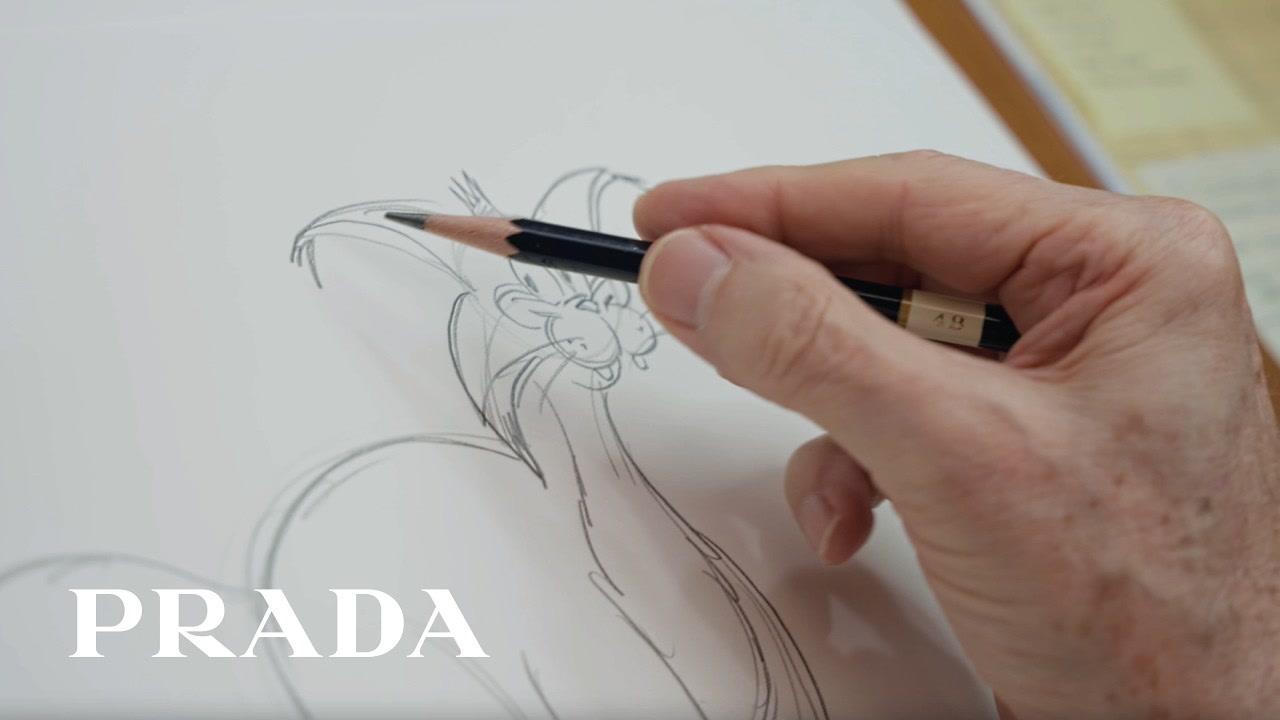
Somewhere in the run-up to the holidays, a fashion house handed its biggest campaign of the year to a team of animators and a stack of pencils. Prada’s Holiday 2026 campaign, called Drawing Prada, was animated entirely by hand, directed by John Pomeroy, a veteran of Don Bluth’s studio, with lead animation from twin brothers Tom and Tony Bancroft. Tom Bancroft drew Mushu in Mulan. Tony Bancroft animated Pumbaa in The Lion King and co-directed Mulan. Trevor Decker News covered the campaign when it debuted this fall, and the detail that lingers is the simplest one: in a season of computer-generated everything, somebody still chose to draw.
A day later came a second headline with the same heartbeat. Disney confirmed that a brand-new Princess and the Frog musical special is in production at Walt Disney Animation Studios for Disney+, a complete musical story with new songs and returning members of the original cast. The choice of title matters. The Princess and the Frog was the 2009 film that brought hand-drawn animation back to Disney’s feature lineup and introduced Tiana, and returning to her world now, with a new hand-crafted story, reads like the studio remembering what that style can do.
Part of what families respond to in these films is visible in every frame. A hand-drawn character was drawn, by a person, a dozen or more times for a single second of screen time, and small imperfections in the line give the movement a warmth that is hard to fake. Mrs. Brisby’s frightened determination in The Secret of NIMH, Fievel’s small figure against a huge new city in An American Tail, Littlefoot’s goodbye in The Land Before Time: the emotions are simple, the stakes are enormous, and the drawings carry both at once.
Don Bluth built that side of the era after leaving Disney in 1979 to start his own studio. The Secret of NIMH arrived in 1982, followed by An American Tail in 1986 and The Land Before Time in 1988, both made with Steven Spielberg’s Amblin Entertainment. In 1997, Bluth and Gary Goldman directed Anastasia, a hand-drawn musical that held its own in the middle of Disney’s strongest run. Bluth’s films tended to be a little darker and a little sadder than the competition, and children at the time seemed to understand that they were not being talked down to.
Disney’s own hand-drawn peak, the run now called the Disney Renaissance, began with The Little Mermaid in 1989. Alan Menken and Howard Ashman gave that film and Beauty and the Beast songs built like Broadway numbers, and Beauty and the Beast went on to become the first animated film ever nominated for the Academy Award for Best Picture. Aladdin followed in 1992 and The Lion King in 1994, and for about ten years the hand-drawn musical was simply what a big family film looked like.
That is the generation now choosing the movies on family night. Parents who wore out these tapes as kids are putting the same films in front of their own children, and the films hold up because their pleasures were never only technical. The jokes were written to land for adults in the room, the songs were written to be sung afterward, and the stories resolve around home, family and keeping a promise, themes that do not date the way software does.
Most of that library is easy to revisit. Disney+ carries the Renaissance films, Anastasia and The Princess and the Frog. The Secret of NIMH currently streams free with ads on Tubi and The Roku Channel, and The Land Before Time streams through the Wonder Project channel on Amazon, while An American Tail is available to rent or buy digitally. Availability shifts, but the shelf itself is not going anywhere.
None of this adds up to hand-drawn animation replacing anything. It adds up to something steadier: a style of filmmaking, built one drawing at a time by people like Pomeroy, the Bancrofts and the artists of Bluth’s and Disney’s studios, that families never actually stopped loving. This fall, between a hand-drawn holiday campaign and a new trip to Tiana’s New Orleans, the rest of the industry seems to be remembering that too.