

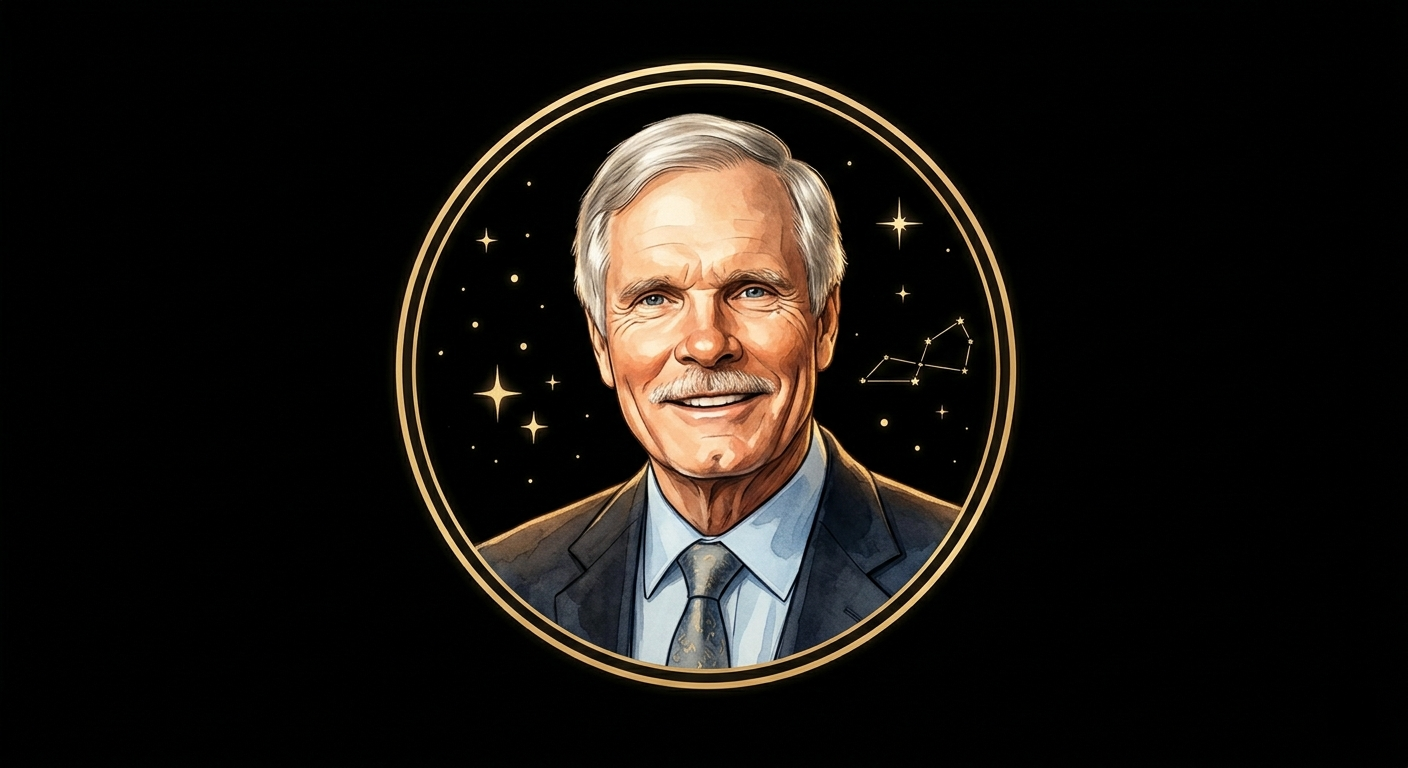
Ted Turner, the Atlanta cable visionary who founded CNN, launched TBS, TNT and Turner Classic Movies, and once owned the MGM film library that anchored a generation of basic-cable viewing, died Wednesday at 87. Turner Enterprises confirmed the death in a news release first reported by CNN, the network he put on the air on June 1, 1980.
He had been living with Lewy body dementia, a progressive brain disorder he disclosed publicly in 2018, and had largely stayed out of public life since. Earlier this year he was hospitalized briefly with pneumonia before being moved to a rehabilitation facility, according to CNN.
CNN Worldwide chairman and CEO Mark Thompson called him “the presiding spirit of CNN” in a statement Wednesday. “Ted was an intensely involved and committed leader, intrepid, fearless and always willing to back a hunch and trust his own judgement,” Thompson said. “Ted is the giant on whose shoulders we stand.”
Robert Edward Turner III was born in Cincinnati on November 19, 1938, and raised in Savannah after his father moved the family south to run a billboard company. He took over the business at 24, after his father’s death in 1963, and rebuilt it. The TV story started in 1970, when he bought a struggling UHF station in Atlanta. Five years later, he beamed it up to a satellite and turned it into the country’s first superstation, WTBS.
That was the breakthrough. Cable operators across the South suddenly had a national signal to carry, stuffed with old movies, sitcom reruns and Atlanta Braves baseball. The Braves were Turner’s, too. He bought them in 1976 for $12 million, picked up the Hawks the next year, and marketed the baseball team, with the kind of nerve that defined him, as “America’s Team.”
CNN launched on June 1, 1980, anchored by the husband-and-wife team of David Walker and Lois Hart. Skeptics called it the “Chicken Noodle Network.” Turner had sunk $21 million into the venture, kept it propped up with TBS profits, and it ran in the red until 1985. By the Gulf War, when CNN crews stayed in Baghdad as bombs fell on January 16, 1991, the joke was over. The network had reinvented what it meant to watch news.
Then came the entertainment empire. In 1986 Turner bought MGM/UA Entertainment for roughly $1.5 billion, a deal that loaded him with debt and forced him to sell off most of the studio almost immediately. He kept the prize, though: the MGM film library, more than 4,000 titles including pre-1948 Warner Bros. and RKO catalog. That library became the backbone of TNT, which launched in 1988 with a broadcast of “Gone with the Wind,” and Turner Classic Movies, which followed in 1994.
Cartoon Network arrived in 1992. “Captain Planet and the Planeteers,” the environmental superhero series Turner co-created and co-wrote, ran from 1990 to 1996 with a celebrity voice cast that pulled in Whoopi Goldberg, Sting and LeVar Burton. In 1993 Turner Broadcasting bought Castle Rock Entertainment and New Line Cinema in the same year, and Turner himself turned up in a cameo as a Confederate colonel in the TNT Civil War epic “Gettysburg,” released that fall.
Wrestling was its own chapter. In 1988 Turner bought Jim Crockett Promotions and rebranded it as World Championship Wrestling, the company that would push Vince McMahon’s WWF harder than any rival had to that point. The turning point came in 1995, when WCW executive Eric Bischoff sat down with Turner and pitched a Monday-night live show on TNT to go head-to-head with “Raw.” Turner greenlit it on the spot. “Monday Nitro” debuted September 4, 1995, from the Mall of America, kicked off the Monday Night Wars, and beat “Raw” in the ratings for 83 weeks straight starting in mid-1996. The McMahon camp ran “Billionaire Ted” parody skits beginning in January 1996. Turner thought they were funny. WCW was sold to McMahon in 2001 under AOL Time Warner, ending one of the most beloved runs in cable wrestling history.
Turner sold Turner Broadcasting to Time Warner in 1996 for $7.5 billion and stayed on as vice chairman, becoming the merged company’s largest individual shareholder. The 2000 AOL deal followed, and his paper fortune, which had peaked at roughly $11 billion, contracted significantly in the years that followed.
Turner married three times. The third was Jane Fonda, who he wed at his ranch near Capps, Florida, on December 21, 1991, and divorced in 2001. Fonda, who has called him her “favorite ex-husband,” paid tribute to him at the GCAPP gala in Atlanta last November, saying their charity “never would have happened if it wasn’t for Ted.” She called him brilliant and credited him with teaching her to laugh on camera, which she said gave her the courage to do “Monster-in-Law” four years after their split.
There were also the Goodwill Games, which he created in 1986 to ease Cold War tensions and gave his superstation Olympic-style programming to broadcast. There were the Atlanta Braves, who won the World Series in 1995 under his ownership. There was the $1 billion gift to the United Nations in 1998 that founded the U.N. Foundation. He co-founded the Nuclear Threat Initiative with former Senator Sam Nunn in 2001. He owned around two million acres at his peak, ran 55,000 bison across his ranches, and put the meat on the menu at Ted’s Montana Grill, the chain he co-founded in 2002.
Time named him Man of the Year in 1991. He got a star on the Hollywood Walk of Fame in 2004. He called CNN the “greatest achievement” of his life and once told staff, before the network even launched, that they would not be signing off “until the world ends.” A tape of a military band playing “Nearer, My God, to Thee,” intended to play at that final sign-off, was logged in CNN’s database for decades, marked “Hold for release till end of world confirmed.”
Turner is survived by his five children, 14 grandchildren and two great-grandchildren. Funeral arrangements have not yet been announced by Turner Enterprises.