

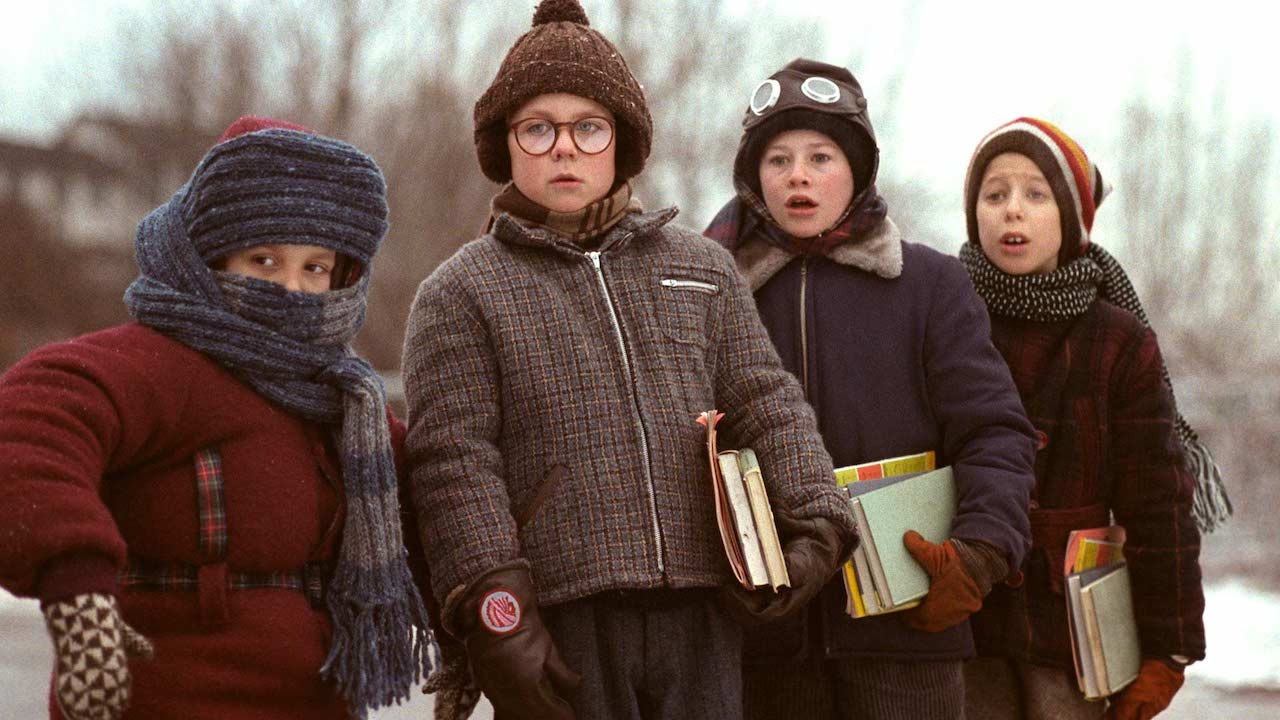
Decades after Ralphie Parker first set his sights on a Red Ryder Carbine Action 200-shot Range Model air rifle, A Christmas Story remains a holiday staple. While families watch the Parker family’s chaotic Christmas every year, the story behind the movie is just as entertaining as the film itself. From hidden cameos to clever movie magic, the making of this classic is full of surprises that even the most dedicated fans might have missed.
The movie actually began long before the cameras started rolling in the early 80s. It was based on the semi-autobiographical radio stories and book In God We Trust: All Others Pay Cash by Jean Shepherd. Shepherd didn’t just provide the source material; he was deeply involved in the film. He served as the narrator, giving the movie its distinct voice of an adult looking back on childhood. If you look closely during the scene at Higbee’s department store, you can actually spot Shepherd himself. He plays the man in line who gruffly tells Ralphie and Randy, “The line starts back there!”
Finding the perfect location to recreate 1940s Indiana was a challenge. Although the movie is set in the fictional town of Hohman, Indiana, it was primarily filmed in two very different cities: Cleveland, Ohio, and Toronto, Ontario. The famous Parker family house is located in Cleveland. At the time of filming, the producers scouted twenty cities before finding the perfect vintage look they needed. The massive Higbee’s department store was also a real location in downtown Cleveland. However, the school scenes were shot in Canada. If you look closely at the background of certain outdoor shots, you might notice the distinct lack of real snow. Filming often took place when there was no snow on the ground, so the crew used everything from potato flakes to firefighter’s foam to create the winter wonderland.
One of the most memorable moments in the film is the “triple dog dare” scene where Flick gets his tongue stuck to the frozen flagpole. Viewers often wince at the thought of how painful that must have been, but it was all a camera trick. A hidden hole was drilled into the flagpole, and a small vacuum suction device was used to gently hold actor Scott Schwartz’s tongue in place. It looked real, but it was completely safe and painless.
The casting of Ralphie was another crucial piece of the puzzle. Director Bob Clark auditioned thousands of children for the role, but he kept coming back to Peter Billingsley, who was the very first child he saw. Billingsley delivered a performance that anchored the entire film. As for the infamous pink bunny suit Ralphie is forced to wear by his Aunt Clara, it was a source of real embarrassment for the young actor, which helped make his on-screen reaction feel genuine. Funnily enough, Billingsley still owns the original bunny suit today.
Then there is the “Major Award”—the leg lamp. Production designer Reuben Freed created the lamp specifically for the movie, though he was inspired by a description in Shepherd’s stories. Three lamps were made for filming, and unfortunately, none of the original props survived the production intact. The lamp became such a cult symbol that you can now buy replicas of all sizes. The house in Cleveland has even been restored to its movie-perfect condition and operates as a museum where fans can tour the rooms and see the lamp glowing in the window.
Despite its current status as a holiday masterpiece, the movie was not a massive blockbuster when it was first released. It performed modestly at the box office and quietly left theaters. Its reputation grew slowly over the years, largely thanks to cable television. When networks began airing 24-hour marathons of the film on Christmas Eve, it allowed a new generation to discover the humor and heart of the Parker family. It transformed from a sleeper hit into a cultural phenomenon that now rivals It’s a Wonderful Life in popularity.
Even the specific toy Ralphie wanted was a blend of fact and fiction. The Red Ryder BB gun was a real product made by Daisy, but the specific model Ralphie describes—with the compass in the stock and “this thing which tells time”—didn’t actually exist in that exact configuration. The filmmakers had to custom-build the gun to match Jean Shepherd’s exaggerated childhood memories. It serves as a perfect symbol for the movie itself: a blend of real nostalgia and slightly exaggerated storytelling that captures exactly what it feels like to be a kid at Christmas.